 Korkut Kaynardag
From Bridges to Photons: Mode Shapes and Wave Propagation in Quantum Mechanics
How the physics of structural vibration and elastic wave propagation reappears in the double-slit experiment.
The double slit as a mode-shape problem
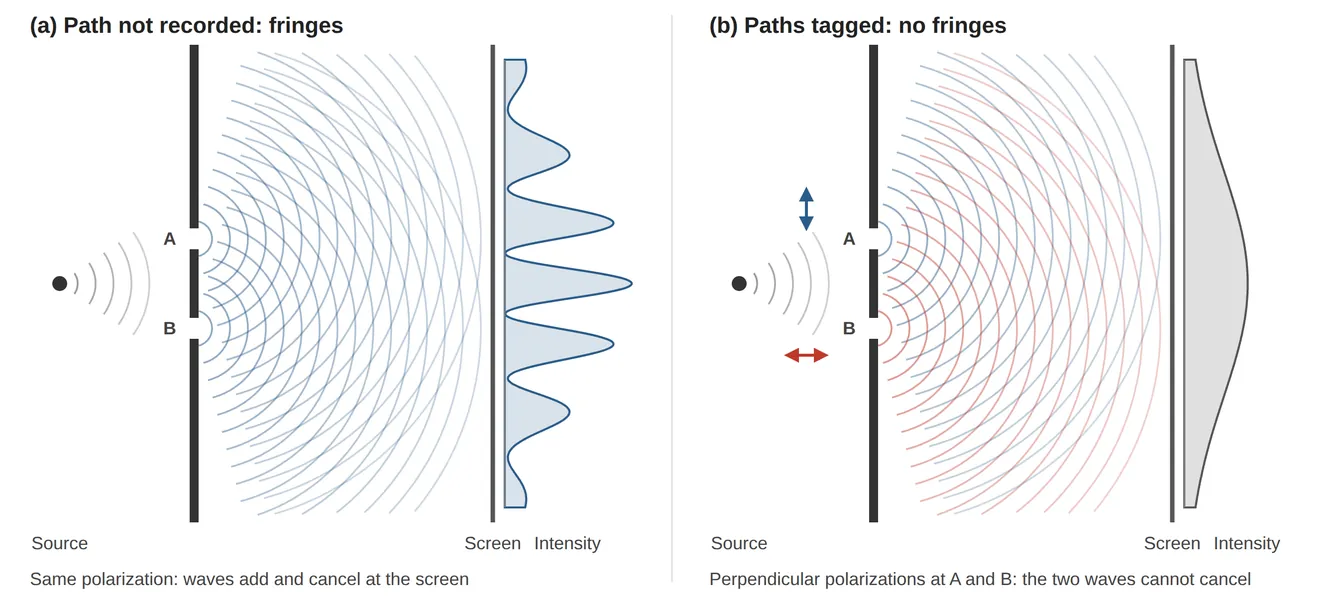
Mode shapes are not limited to beams, plates, and bridges. The double-slit experiment, the classic demonstration of quantum behavior, can also be read as a mode-shape problem. Light obeys a wave equation, and the source, the two slits, and the space behind them act as boundary conditions that fix the spatial shape of the field, much as supports and geometry fix the modes of a structure. Strictly, this field is a steady-state harmonic solution driven by the source, closer to an operating deflection shape than to a free-vibration eigenmode, but in optics it is still called a mode. The contributions from the two slits superpose linearly: where they arrive in phase the field is strong, and where they arrive out of phase it cancels, producing the bright and dark fringes in Figure 1(a). Remarkably, this holds even when photons are sent one at a time. Each photon occupies the same mode, and although it is detected as a single dot, the probability of where it lands is proportional to the squared amplitude of the mode at that point, so thousands of dots gradually trace out the mode shape.
Why observation removes the fringes
The fringes disappear when the path is recorded, and the reason is not that the photon somehow knows it is being watched. To learn which slit a photon used, some physical system, such as a detector, a polarizer, or even a stray atom, must interact with it and end up in a different state for each path. This is the step that destroys coherence. In the simplest picture, the detector gives the photon a small random kick. A kick sharp enough to reveal the slit must locate the photon to better than half the slit separation, and by the uncertainty principle it then carries enough momentum spread to shift the fringes by a substantial fraction of their spacing, differently for each photon. The fringes wash out on average, exactly as two vibration sources with random relative phase produce no stable interference.
The kick, however, is only one mechanism. If the slits are tagged with perpendicular polarizations, nothing is pushed and the relative phase stays well defined, yet the two contributions now vibrate in orthogonal directions and cannot cancel, as in Figure 1(b). What the two cases share is that the paths have become distinguishable. Formally, the interference term is multiplied by the overlap between the detector's "A" and "B" states: identical records leave full fringes, completely different records remove them, and partial records give partial fringes. This trade-off is captured by the duality relation V² + D² ≤ 1, where V is the fringe visibility and D measures how reliably the path can be identified. The loss of fringes is therefore not a flaw of clumsy detectors but a built-in property of wave superposition: the more a system records about the path, the less the two paths can interfere.
Why not two bright lines?
A common illustration claims that, once the path is observed, particles pile up in two bright lines behind the slits. For a typical setup this is not what happens. With the path recorded, the screen shows the sum of the two single-slit diffraction patterns, P = PA + PB, with no interference term. Each single-slit pattern has a width on the screen of roughly λL/a, where a is the slit width and L is the distance to the screen. In the usual far-field arrangement this width is much larger than the slit separation d, so the two envelopes overlap almost completely and add up to a single broad hump, as in Figure 1(b). Two separate bands appear only in the near field, roughly when ad/(λL) > 1, where the light still carries the shape of the apertures. The distinction is familiar from ultrasonic transducers: close to the aperture the beam keeps the aperture's shape, while far away it spreads into a broad directivity lobe.
Why waves?
Why nature propagates everything as waves remains an open question. Part of the answer is known: physical laws are local and consistent with relativity, fields built on these principles carry disturbances as waves, and linearity lets those waves superpose and interfere. Attempts to reconstruct quantum mechanics from simple assumptions also suggest that amplitudes which add and cancel may be unavoidable. But why the universe obeys these rules at all, and why a spread-out wave is always detected as a single lump at one random point, is not yet understood. What is clear is how far the wave picture reaches. Electrons, neutrons, atoms, and even large molecules have produced double-slit fringes, and in modern physics every particle is treated as an excitation of a field that propagates according to a wave equation. The lumps appear only at detection; everything in between is wave propagation. Seen this way, the mode shapes of a vibrating bridge and the fringes behind two slits are two expressions of the same underlying principle.
Waves and Data. From elastic waves in a bridge to the matter waves of single atoms, the physical world is described by wave propagation. What we observe arrives as discrete measurements: sensor readings, detector clicks, dots on a screen. Data is how we recover the waves behind them.