 Korkut Kaynardag
Structural Health Monitoring (SHM) and Non-destructive Testing (NDT)
Have a structure (building, bridge, wind turbine, industrial facility, railway track, roads, or similar)? Do you want to:
INSPECT | MONITOR | MODEL |
|---|---|---|
Assess the current condition (do any defects or deterioration exist?) | Perform long-term monitoring under conditions such as earthquakes, corrosion, deterioration, extreme winds, operational conditions, and similar? | Update the numerical or analytical model of the structure based on the measurements for more reliable simulations? |
Then, SHM and NDT are for you!
It allows you to monitor and inspect your structures for any structural problems.
HOW IT WORKS?

Structure(s)

Sensors on structure(s)

Data analysis

Decision making
Uses data recorded from sensors attached to structures to capture one or more parameters, such as vibration, micro-level acoustic waves, ultrasonic waves, displacement, and strain.
Sensors can be installed permanently for long-term monitoring or temporarily for short-term monitoring.
Contact, non-contact, or both types of sensors can be used. Contact sensors are usually accelerometers, velocimeters, tiltmeters, strain gauges, acoustic transducers, and ultrasonic devices. Non-contact sensors are typically laser Doppler vibrometers and air-coupled acoustic transducers.
ANALYSIS
Data recorded from the sensors is analyzed using signal processing, system identification (in this case, the structure itself is treated as the system), artificial intelligence, and other advanced mathematical methods.
TYPES OF MONITORING
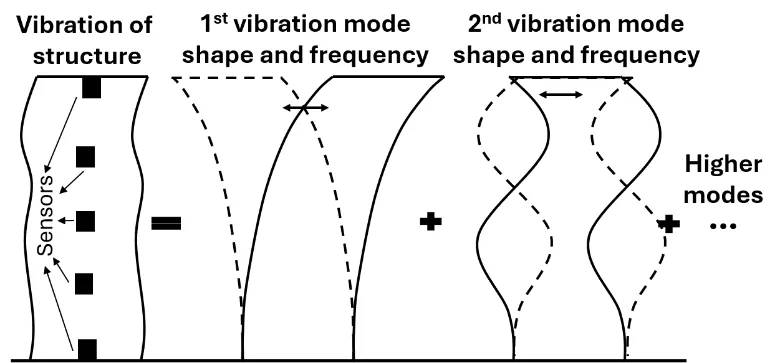
Vibration-based monitoring: the data recorded from sensors (e.g., from accelerometers) is used to identify the natural frequencies, mode shapes, and damping ratios of structures. In some cases, mathematical models of the structures are also developed to complement the measurements and further characterize these dynamic properties. Using the parameters obtained from measurements and/or models, condition assessment, long-term monitoring, or model updating for more reliable simulations can then be achieved. In vibration-based monitoring, either 1) naturally occurring vibrations induced by occupancy, environmental, and operational conditions (passive monitoring), or 2) vibrations induced externally through impact hammers, mass shakers, or other actuators (active monitoring) can be used. These types of monitoring are usually named after the excitation type (e.g., passive vibration-based monitoring).
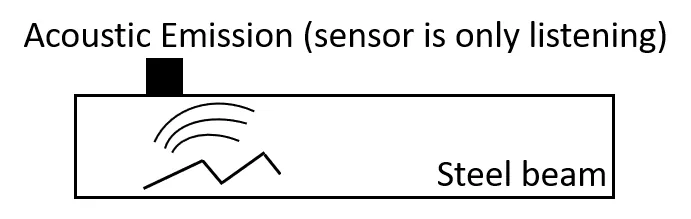
Acoustic emission-based monitoring: In this case, monitoring is performed by listening for acoustic emissions that are micro-level elastic waves that propagate through a structure, similar to the ripples created when a stone is thrown into a lake. Growing cracks or other defects release these waves themselves, similar to creaking sound produced by a branch just before it breaks. Because the waves originate directly from the defect (no external force), sensors listen for the waves the structure generates on its own (passive monitoring).
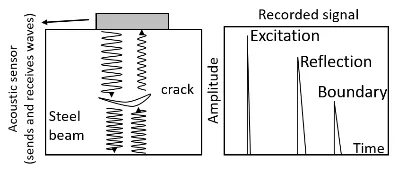
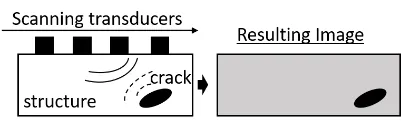
Ultrasonic wave-based monitoring: This is very similar to acoustic emission-based monitoring, except that waves are actively sent into the structure and listen for the reflections. It can be performed without imaging, or when multiple sensors send waves in different directions as an imaging (scanning) technique, much like an ultrasound scan performed by a doctor.
Other types of monitoring: Such as radiographic testing (X-rays) and eddy current testing, can also be used to detect small or hidden defects.
WHAT CAN BE DONE WITH THE OUTCOMES?
The owner of the structures and/or government agencies can manage maintenance tasks more efficiently, plan retrofitting more effectively when serious defects exist, and allocate budget and resources more reliably based on the condition of the structures.
Accordingly, we keep our structures, and more importantly, we keep ourselves safe!